Mushrooms & the Gut-Brain Axis
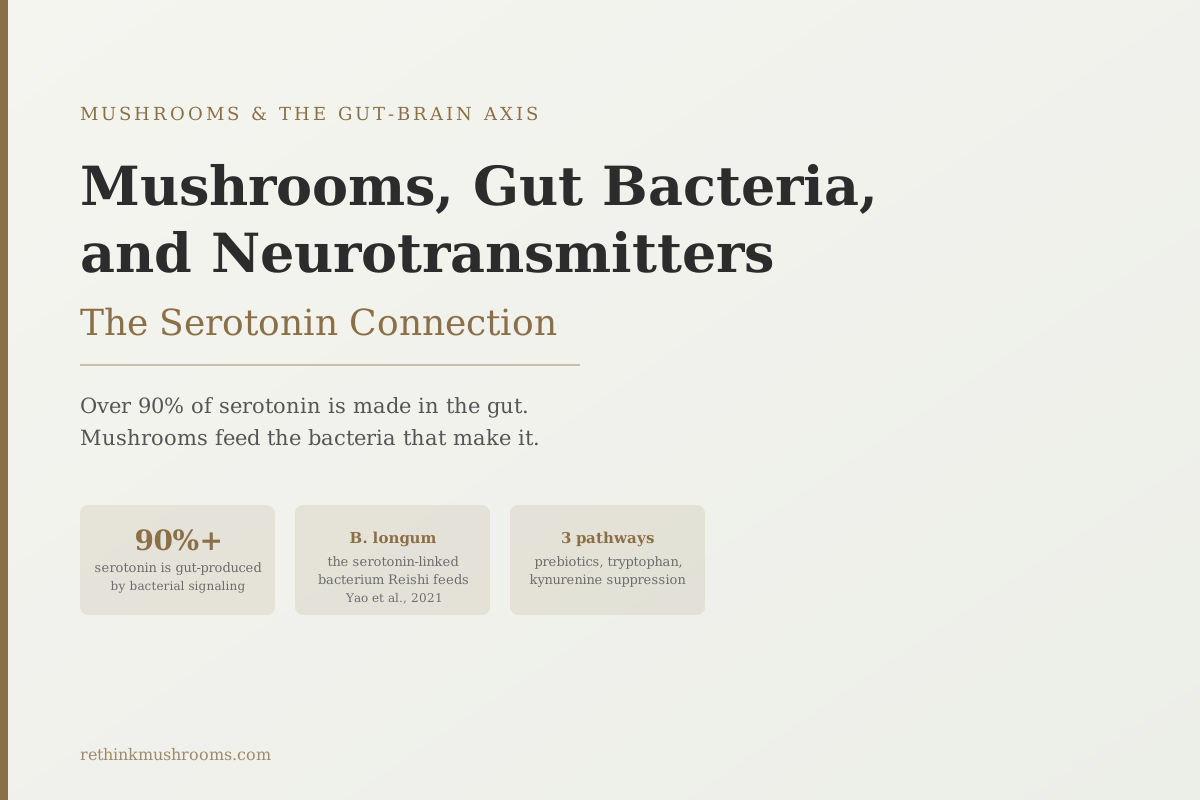
90% gut-produced
Over 90% of the body's serotonin is made in the gut, not the brain. A 2021 study in Scientific Reports found that Ganoderma lucidum promotes sleep by modulating the gut bacteria — specifically Bifidobacterium animalis — that drive serotonin-associated signaling.
Yao et al., Scientific Reports, 2021
Bifidobacterium animalis
the Bifidobacterium species specifically enriched by Ganoderma lucidum extract in Yao 2021, correlated with higher hypothalamic serotonin
5-HTP
5-hydroxy-L-tryptophan, the direct one-step serotonin precursor found in edible mushrooms — documented by Fijałkowska et al. (2022)
Multiple pathways
mushrooms affect neurotransmitter production through at least three routes: prebiotic feeding, tryptophan supply, and anti-inflammatory tryptophan preservation
Yao et al., Scientific Reports, 2021
 View as image ↗
Over 90% of the body's serotonin is produced in the gut, not the brain. The brain receives a fraction of serotonin through indirect signaling pathways; the vast majority circulates in the intestinal lining, where gut bacteria directly influence how much gets made. This single fact changes the question about mushrooms, gut bacteria, and neurotransmitter production: if serotonin is primarily a gut product, anything that shifts gut bacterial populations also shifts serotonin-related signaling. And mushroom polysaccharides are among the most studied dietary compounds for doing exactly that.
A 2021 study in Scientific Reports demonstrated this chain directly: Ganoderma lucidum (Reishi) promoted sleep in mice by modulating gut microbiota composition, with Bifidobacterium (specifically Bifidobacterium animalis), a genus associated with serotonin production, as the identified mechanism.[1] When the researchers eliminated the gut bacteria using antibiotics, the sleep-promoting effect disappeared. The mushroom was not acting on the brain directly. It was acting on gut bacteria, which then acted on the brain.
For how mushrooms modify gut microbiota composition broadly, see the complete guide to mushrooms as prebiotics. This article focuses specifically on the neurotransmitter production end of that chain.
Key Takeaways
- Yao et al. (2021) in Scientific Reports found that Ganoderma lucidum promotes sleep through gut microbiota modulation, with Bifidobacterium (specifically B. animalis) as the serotonin-associated bacteria — eliminating gut bacteria with antibiotics eliminated the sleep effect, confirming the gut pathway is required, not just parallel
- Fijałkowska et al. (2022) in Foods documented that edible mushrooms contain 5-HTP (5-hydroxy-L-tryptophan) — the direct, one-step precursor the body converts to serotonin — and reviewed how mushroom dietary supplementation intersects with the stress-serotonin system central to major depressive disorder
- Lazur et al. (2023) in Antioxidants identified multiple antidepressant mechanisms in medicinal mushrooms, including gut microbiota modulation, HPA axis regulation, and BDNF upregulation — the kynurenine pathway competition is specifically identified as a target through which mushrooms' anti-inflammatory effects preserve tryptophan for serotonin synthesis
- Yin et al. (2020) in Carbohydrate Polymers found that mushroom polysaccharides specifically enrich SCFA-producing bacteria — the short-chain fatty acids these bacteria produce influence the gut environment that supports serotonin-producing cells
- Three separate mushroom species (Ganoderma/Reishi, Cordyceps militaris, and Poria cocos) independently demonstrate mood-related effects in animal models, suggesting a class-wide mechanism rather than species-specific effects
- The 2025 Gong review in Molecular Nutrition & Food Research explicitly frames edible and medicinal fungi as "candidate natural antidepressants" through gut microbiota-mediated mechanisms — the most current research positioning for this topic
Mechanism · Mushroom → Serotonin
Three Routes From Mushroom to Serotonin
Over 90% of serotonin is made in the gut. Mushrooms act on that production through three independent, converging routes — all preclinical.
Prebiotic feeding
Beta-glucan polysaccharides
Mushroom fiber selectively enriches Bifidobacterium (Yao 2021 identified Bifidobacterium animalis), which stimulates enterochromaffin cells to release serotonin.
Bifidobacterium → enterochromaffin serotonin
Yao 2021; Yin 2020
Direct precursor supply
5-HTP in mushroom tissue
Edible mushrooms contain 5-HTP — the direct, one-step precursor to serotonin — bypassing the rate-limiting tryptophan-to-5-HTP conversion.
5-HTP → serotonin (one step)
Fijałkowska 2022
Anti-inflammatory preservation
Reduced gut & systemic inflammation
Lower inflammation stops tryptophan being diverted down the kynurenine pathway, leaving more available for serotonin synthesis.
Tryptophan preserved for serotonin
Lazur 2023; Gong 2025
All routes demonstrated in animal or in-vitro models; no human neurotransmitter-level trial exists for any mushroom preparation.
Where Neurotransmitters Actually Come From: The Gut's Role
The common mental model of neurotransmitters locates them in the brain. This is mostly wrong for serotonin.
Over 90% of the body's serotonin is produced by enterochromaffin cells, specialized cells that line the intestinal wall. These cells don't operate independently — they take signals from gut bacteria that sit directly adjacent to them. Specific bacterial populations, particularly Bifidobacterium, Lactobacillus, and spore-forming bacteria, produce metabolites that stimulate the enterochromaffin cells to release serotonin. Change the bacterial population, and you change the serotonin signal.
The serotonin produced in the gut doesn't cross the blood-brain barrier into the brain. But it influences the brain through three other routes: the vagus nerve (a direct communication channel between gut and brainstem), immune signaling (gut bacteria influence cytokine levels that affect brain function), and short-chain fatty acids (SCFAs), metabolic byproducts of bacterial fermentation that can cross the blood-brain barrier.
This means gut bacteria affect brain serotonin not by shipping molecules to the brain directly, but by changing the signaling environment that the brain responds to.
Dopamine follows a similar pattern. A subset of gut bacteria can produce the dopamine precursor L-DOPA, and gut bacteria also produce GABA, an inhibitory neurotransmitter that reduces neural excitability. The gut is not just a digestion machine. It is, by neurotransmitter production, a second nervous system.
Over 90% of the body's serotonin is produced in the gut by enterochromaffin cells — stimulated by gut bacteria including Bifidobacterium and specific spore-forming bacteria. Mushrooms feed these serotonin-associated bacteria through their beta-glucan polysaccharides, and edible mushrooms also contain 5-HTP, the direct one-step precursor to serotonin synthesis.[1]
Yin et al. (2020) in Carbohydrate Polymers confirmed that mushroom polysaccharides specifically enrich SCFA-producing bacterial populations and promote beneficial bacteria while reducing harmful species.[4] This establishes mushrooms as prebiotic compounds that selectively feed the bacterial populations most relevant to downstream neurotransmitter signaling. For the complete prebiotic mechanism, including which fiber structures feed which bacterial species, see how mushroom prebiotics influence brain function through the gut.
Reishi and Bifidobacterium: The Most Direct Evidence
Most research on gut bacteria and neurotransmitters stops at the population level — "this treatment increases Bifidobacterium" — without showing what that increase actually produces downstream. Yao et al. (2021) went further.[1]
The study tested Ganoderma lucidum in mice and measured sleep outcomes. Reishi promoted sleep — that part was consistent with prior findings. But the researchers then ran an experiment to confirm the mechanism: they treated a second group of mice with antibiotics to eliminate their gut bacteria, then gave them the same Reishi. The sleep-promoting effect disappeared.
This is the key result. It means Reishi's sleep effect is not from a compound in the mushroom acting directly on the brain. It's from something the mushroom does to the gut bacteria, which then affects the brain. When the bacteria are removed, the effect is gone.
The specific bacterial change was an increase in Bifidobacterium — specifically Bifidobacterium animalis — identified in the study as serotonin-associated bacteria and negatively correlated with sleep latency. Bifidobacterium species are among the most studied serotonin-relevant gut bacteria: they stimulate serotonin release from enterochromaffin cells through metabolites produced during fiber fermentation.
What this study shows, more than any other in the mushroom literature, is that the gut pathway is not incidental. It is the mechanism. For how Reishi's direct brain effects on sleep quality differ from its gut-mediated effects, see how Reishi improves sleep quality. For the full evidence on Lion's Mane and serotonin signaling, see how Lion's Mane affects serotonin and dopamine pathways.
Yao et al. (2021) · Scientific Reports
- Population
- Mice (pentobarbital sleep model), with a parallel antibiotic-depleted group
- Intervention
- Acidic alcohol extract of Ganoderma lucidum mycelia (GLAA), 25–100 mg/kg for 28 days
- Comparator
- Same extract given after gut-microbiota depletion with antibiotics
- Finding
- GLAA shortened sleep latency, raised hypothalamic 5-hydroxytryptamine (serotonin), and enriched Bifidobacterium (including B. animalis). Both the sleep effect and the sleep-correlated metabolite shifts disappeared once the gut bacteria were depleted — establishing the gut as a required intermediary, not a bystander.
preliminary Animal model; demonstrates mechanism, not human efficacy
Yao et al., Scientific Reports, 2021 (PMID 34211003)
Mushrooms as a Source of Tryptophan: The Precursor Pathway
Beyond feeding serotonin-producing bacteria, edible mushrooms provide the raw material that bacteria and gut cells need to make serotonin in the first place.
Serotonin is made from tryptophan in two steps: tryptophan is first converted to 5-HTP (5-hydroxytryptophan), and 5-HTP is then converted to serotonin. The first step is rate-limiting. Most people associate tryptophan with turkey, but Fijałkowska et al. (2022) in Foods documented something more useful: edible mushrooms contain 5-HTP itself — the direct, one-step precursor to serotonin — and explicitly linked mushroom consumption to the serotonin pathway targeted in depression treatment.[2]
Edible mushrooms can affect neurotransmitter systems through three routes:
Direct precursor supply. Mushrooms contain 5-HTP, which is only a single enzymatic step from serotonin — bypassing the rate-limiting tryptophan-to-5-HTP conversion. Both gut bacteria and gut cells participate in the final step to serotonin.
Dopamine pathway support. Mushrooms also contain L-tyrosine, the amino acid precursor to dopamine. Dopamine is the neurotransmitter associated with motivation, reward, and motor control. Tyrosine availability is one limiting factor in dopamine synthesis.
HPA axis modulation. The hypothalamic-pituitary-adrenal axis is the body's stress response system. Chronic HPA activation (chronic stress) suppresses neurotransmitter production, including serotonin. Mushroom compounds appear to reduce HPA dysregulation in animal stress models, potentially protecting neurotransmitter production from stress-induced suppression.
This is the dietary angle that most mushroom content misses entirely: mushrooms aren't just modulators of gut bacteria. They are also sources of the precursor molecules that bacteria and cells use to make neurotransmitters. For the microbiome-mood connection and the specific bacteria implicated in depression, see the microbiome-mood connection.
The Kynurenine Problem: How Inflammation Steals Serotonin
Here is a mechanism that explains why treating gut inflammation matters for mood — and why mushrooms' anti-inflammatory effects may have a neurotransmitter-related benefit.
Tryptophan doesn't automatically become serotonin. It enters a metabolic competition. When inflammation is present in the gut or systemically, the body preferentially routes tryptophan toward the kynurenine pathway rather than toward serotonin synthesis. Kynurenine metabolites are not mood-supporting signals; some are actually neurotoxic at high levels.
Lazur et al. (2023) in Antioxidants reviewed this pathway specifically in the context of medicinal mushrooms and identified it as one of the mechanisms through which mushrooms may produce antidepressant-like effects.[3] The logic: mushrooms reduce gut and systemic inflammation; reduced inflammation allows more tryptophan to route toward serotonin rather than kynurenine; more tryptophan-to-serotonin conversion means better serotonin availability.
The Lazur review covered five separate antidepressant mechanisms in medicinal mushrooms:
- Gut microbiota modulation (the primary pathway described throughout this article)
- Tryptophan-kynurenine pathway normalization (the inflammation-diversion mechanism)
- HPA axis modulation (stress response regulation)
- Neuroinflammation reduction (direct anti-inflammatory effects in brain tissue)
- BDNF upregulation (brain-derived neurotrophic factor, a protein critical for neuron growth)
The convergence of five independent mechanisms, all pointing toward antidepressant-like effects, is what led Gong et al. (2025) in Molecular Nutrition & Food Research to frame edible and medicinal fungi explicitly as "candidate natural antidepressants" in a 2025 review — the most current and directional statement in this research area.[5]
Multiple Species, Same Direction: A Pattern That Suggests a Class Effect
If the gut-neurotransmitter pathway were unique to one mushroom species, it would suggest a species-specific compound was responsible. But the pattern extends across at least four independent species studied in animal models.
Ganoderma lucidum (Reishi): The Yao 2021 study described above — gut microbiota-dependent serotonin pathway for sleep.[1]
Cordyceps militaris: Lin et al. (2021) in Journal of Ethnopharmacology found antidepressant-like effects from Cordyceps militaris water extract in a chronic stress animal model.[6] The mechanism in this case was ROCK2/PTEN/Akt signaling, an intracellular pathway that regulates cell survival and neuroplasticity — a different route to the same destination.
Poria cocos (Fu Ling): Huang et al. (2020) in Journal of Ethnopharmacology found that a Poria cocos water extract reduced depression-like behavior in chronically stressed rats by suppressing neuroinflammation, specifically by lowering inflammatory cytokines that interfere with neurotransmitter signaling.[7]
Pleurotus ostreatus (Oyster mushroom): Törős et al. (2023) in Foods documented that oyster mushroom contains both prebiotic compounds that feed beneficial bacteria and antimicrobial compounds that reduce pathogenic bacteria.[8] This dual action — feeding the beneficial, reducing the harmful — is the most efficient way to shift the gut microbiome toward neurotransmitter-supporting populations.
Zhao et al. (2023) in Frontiers in Nutrition synthesized the polysaccharide-microbiota relationship across multiple edible mushroom species and confirmed the consistent pattern: mushroom polysaccharides enrich microbiome diversity, increase beneficial bacteria, and produce cascading downstream health effects through microbial metabolites.[9]
Four species, working through at least three different molecular routes, all producing convergent effects on mood-relevant neurotransmitter pathways. This pattern suggests the mechanism is not compound-specific but is a property shared across mushroom polysaccharides and triterpenoids as classes.
The evidence limit. Every study described here used animal models except for the in vitro turkey tail study (discussed in the sibling article on prebiotic mechanisms). No randomized controlled trial has measured neurotransmitter levels before and after a course of any mushroom supplement in humans. The mechanistic evidence is coherent and the animal findings are consistent, but direct human neurotransmitter data does not exist for any mushroom preparation. For the closest human evidence — the Lion's Mane cognitive RCT — see the gut-brain axis and mushrooms: how your microbiome mediates cognitive benefits.
For the broader landscape of mushroom species and their prebiotic profiles, see which mushrooms are the best prebiotics. And for how this neurotransmitter connection fits into the complete gut-brain picture, see mushrooms and the gut-brain axis.
- Cell & Lab Studiescompleted
Polysaccharide–microbiota and SCFA mechanisms characterized in vitro (Yin 2020; Zhao 2023); mushroom 5-HTP content documented (Fijałkowska 2022)
- Animal Studiescurrent
Gut-dependent serotonin/sleep pathway (Yao 2021) and antidepressant-like effects across Cordyceps (Lin 2021) and Poria cocos (Huang 2020) rodent stress models
- Case Reports & Early Seriesmissing
No human case series measuring neurotransmitter or mood endpoints for any mushroom preparation
- Small Human Trialsmissing
No trial has measured serotonin, 5-HTP, or kynurenine markers before and after mushroom supplementation
- Large Randomized Trialsmissing
None
- Meta-Analyses & Systematic Reviewsmissing
Narrative reviews exist (Lazur 2023; Gong 2025) but no quantitative meta-analysis of human neurotransmitter endpoints
The mechanism is coherent and consistent across cell and animal work, and multiple species converge on the same direction. But the entire evidence base is preclinical — no human study has measured a neurotransmitter before and after any mushroom. 'Mushrooms support serotonin production' is mechanistically supported, not clinically demonstrated.
Aggregate of Yao 2021, Fijałkowska 2022, Lazur 2023, Yin 2020, Gong 2025, Lin 2021, Huang 2020, Zhao 2023
Safety — mood, medication, and serotonin
ModerateThis is a mechanism, not a treatment — and 5-HTP plus serotonergic drugs is a real interaction
Concern
Mushrooms are being described here as influencing serotonin pathways. That does not make them a treatment for depression, anxiety, or insomnia, and none of the evidence is human. Separately, 5-HTP raises serotonin, so combining concentrated 5-HTP supplements with SSRIs, SNRIs, MAOIs, or other serotonergic medications can in principle contribute to serotonin excess.
What the research says
Culinary and supplemental mushrooms are foods, not antidepressants; do not stop or replace prescribed treatment based on preclinical mechanism. This article is educational and is not medical advice.
Particularly relevant for: Anyone taking antidepressants or other serotonergic medication, or managing a diagnosed mood or sleep disorder
What to do
Talk to your physician or pharmacist before combining mushroom or 5-HTP supplements with any serotonergic medication.
Mechanistic reviews (Lazur 2023; Gong 2025); general serotonergic-interaction pharmacology
The Bottom Line
Serotonin is primarily a gut product, and gut bacteria are the key intermediary between mushroom consumption and neurotransmitter-related effects. The Yao 2021 Scientific Reports study showed that Ganoderma's sleep effect requires gut bacteria — eliminating the bacteria eliminated the effect. Edible mushrooms support serotonin through three routes: feeding Bifidobacterium and other serotonin-associated bacteria, supplying 5-HTP as a direct serotonin precursor, and reducing inflammation that would otherwise divert tryptophan toward kynurenine. Multiple species (Reishi, Cordyceps, Poria cocos, Oyster mushroom) independently show mood-relevant effects, suggesting a class mechanism. All evidence is preclinical.
Frequently Asked Questions
Sources & References
- 1RTHM-00731·Yao, Chunyan et al. (2021). “Ganoderma lucidum promotes sleep through a gut microbiota-dependent and serotonin-involved pathway in mice..” Scientific reports.Study breakdown →PubMed →↩
- 2RTHM-01514·Fijałkowska, Agata et al. (2022). “Edible Mushrooms as a Potential Component of Dietary Interventions for Major Depressive Disorder..” Foods (Basel.Study breakdown →PubMed →↩
- 3RTHM-00837·Lazur, Jan et al. (2023). “Discovering the Potential Mechanisms of Medicinal Mushrooms Antidepressant Activity: A Review..” Antioxidants (Basel.Study breakdown →PubMed →↩
- 4RTHM-01308·Yin, Chaomin et al. (2020). “The Impact of Mushroom Polysaccharides on Gut Microbiota and Its Beneficial Effects to Host: A Review..” Carbohydrate polymers.Study breakdown →PubMed →↩
- 5RTHM-02087·Gong, Pin et al. (2025). “Edible and Medicinal Fungi as Candidate Natural Antidepressants: Mechanisms and Nutritional Implications..” Molecular nutrition & food research.Study breakdown →PubMed →↩
- 6RTHM-00700·Lin, Yu-En et al. (2021). “Antidepressant-like effects of water extract of Cordyceps militaris (Linn.) Link by modulation of ROCK2/PTEN/Akt signaling in an unpredictable chronic mild stress-induced animal model..” Journal of ethnopharmacology.Study breakdown →PubMed →↩
- 7RTHM-01204·Huang, Yun-Ju et al. (2020). “Poria cocos water extract ameliorates the behavioral deficits induced by unpredictable chronic mild stress in rats by down-regulating inflammation..” Journal of ethnopharmacology.Study breakdown →PubMed →↩
- 8RTHM-00855·Törős, Gréta et al. (2023). “Modulation of the Gut Microbiota with Prebiotics and Antimicrobial Agents from Pleurotus ostreatus Mushroom..” Foods (Basel.Study breakdown →PubMed →↩
- 9RTHM-01836·Zhao, Qilong et al. (2023). “The benefits of edible mushroom polysaccharides for health and their influence on gut microbiota: a review..” Frontiers in nutrition.Study breakdown →PubMed →↩