King Trumpet Cooking
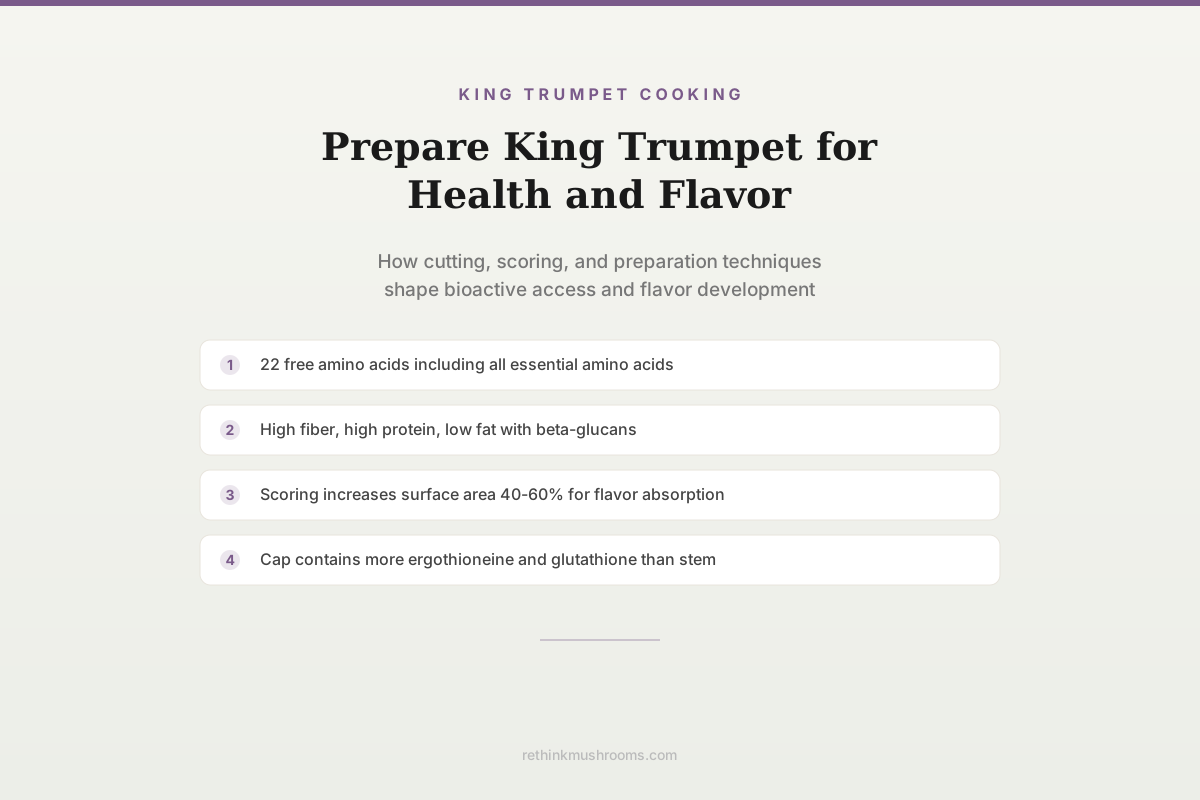
22 amino acids
King trumpet mushrooms contain all essential amino acids, with leucine (5.11-11.24 mg/g dry weight) and alanine (4.74-8.54 mg/g) predominating. Preparation method determines how much of this profile reaches digestion.
Tagkouli et al., Molecules, 2020
10 Studies
on P. eryngii preparation and nutrition
71%
phenolic loss from extended boiling
Low Cal
high fiber, protein, low fat profile
Tagkouli et al., Molecules, 2020
 View as image ↗
King trumpet mushrooms (Pleurotus eryngii) have the thickest stems in the oyster mushroom family, a dense texture that absorbs marinades, and a nutritional profile that includes all essential amino acids, beta-glucans, ergothioneine, and dietary fiber. Most preparation guides focus on flavor alone. This one starts with the science: what bioactive compounds exist in the raw mushroom, how cutting and processing techniques alter their accessibility, and what the research says about retaining both nutrition and taste. For a detailed breakdown of how cooking methods affect king trumpet bioactive compounds, see the companion article. For the complete nutritional profile, see the dedicated analysis.
Key Takeaways
- King trumpet mushrooms contain 22 free amino acids including all essential amino acids, with leucine (5.11-11.24 mg/g dry weight), alanine (4.74-8.54 mg/g), and glutamine (3.35-8.28 mg/g) predominating (Tagkouli et al., 2020)
- P. eryngii chips had high fiber, high protein, low fat, no added sugars, high ergosterol and beta-glucans, with an NRF9.3 nutritional quality score substantially exceeding most commercial snacks (Amerikanou et al., 2023)
- Freeze drying retained the most amino acids and physicochemical properties of P. eryngii, while microwave drying caused the most severe nutrient and amino acid losses (Yang et al., 2020)
- P. eryngii replaced pork back fat in sausages, reducing fat content and energy value while increasing protein (+14%), total dietary fiber, and water-holding capacity with acceptable sensory scores (Wang et al., 2019)
- Dietary P. eryngii at 1-3% reversed colitis-induced microbiota shifts in mice, increased short-chain fatty acids, and reduced pro-inflammatory cytokines in colonic mucosa (Hu et al., 2019)
- Ergothioneine levels in mushrooms range from 0.15 to 7.27 mg/g dry weight, with higher concentrations in the cap than the stem (Kalaras et al., 2017)
Selecting and Storing King Trumpets
Fresh king trumpet mushrooms should feel firm and dry with pale beige to white stems and small brown caps. Avoid any with slimy surfaces, dark discoloration, or soft spots. Unlike many mushrooms that deteriorate within days, king trumpets have a relatively long refrigerator shelf life of 7 to 10 days when stored properly.
Storage matters for bioactive retention. Yang et al. (2020) demonstrated that drying method dramatically affects the retention of nutritional components and amino acids in P. eryngii. Among six drying methods tested (natural air, hot-air, vacuum, infrared, microwave, and freeze drying), freeze drying preserved the most nutrients and physical characteristics. Microwave drying caused the most severe losses of amino acids and damaged physicochemical properties despite having the shortest processing time.[1]
For fresh storage: wrap king trumpets loosely in a paper towel inside a partially open bag in the refrigerator. The paper towel absorbs excess moisture that would otherwise promote bacterial growth, while the open bag prevents condensation buildup. Do not wash before storing. Water on the mushroom surface accelerates decomposition and can leach water-soluble compounds like free phenolics.
For longer preservation, slicing and dehydrating at low temperature (40 degrees C hot-air drying) retains amino acids and physical characteristics better than high-temperature methods. If you dehydrate at home, aim for the lowest effective temperature your dehydrator supports.
Yang et al. (2020) · Journal of Food Science
- Population
- Pleurotus eryngii fruiting bodies
- Intervention
- Six drying methods: natural air, hot-air, vacuum, infrared, microwave, and freeze drying
- Comparator
- Compared for retention of nutritional components, free amino acids, and physical structure
- Finding
- Freeze drying retained the most amino acids and best preserved physicochemical properties and microstructure. Microwave drying caused the most severe losses of main nutrients and free amino acids despite the shortest processing time.
narrow-scope This is a food-processing comparison of a single species, not a health-outcome trial. It tells you which preservation method protects the nutrient profile — freeze drying at home, or low-temperature hot-air drying as a practical alternative — not that dried king trumpet treats any condition.
Yang et al., 2020
Cleaning: Why Less Water Is Better
King trumpet mushrooms grow on cultivated substrates in controlled environments, so they carry less debris than wild-foraged species. The standard recommendation is to wipe them with a damp cloth or brush rather than rinsing under running water.
The scientific basis for this recommendation goes beyond preventing sogginess. Li and Shah (2013) showed that water contact reduces free phenolic content in P. eryngii dramatically. Boiling-treated samples retained only 95 mcg GAE/g dry weight of free phenolics compared to 316 mcg in freeze-dried samples. While brief rinsing is not equivalent to boiling, the same principle applies: water-soluble phenolic compounds migrate out of the mushroom tissue and into any water that contacts the surface.[2]
If the mushrooms are visibly dirty, a quick rinse followed by immediate patting dry with paper towels is acceptable. The key is minimizing water contact time and surface moisture before cooking.
Cutting Techniques and Nutrient Access
How you cut a king trumpet determines both the texture during cooking and the surface area available for bioactive compound release. The chitin-rich cell walls of fungi are partially indigestible to humans, so mechanical disruption through cutting, scoring, or shredding increases the accessibility of intracellular compounds.
Thick medallions (scallop cuts): Slice stems crosswise into 2 cm rounds. This maximizes the dense, meaty texture and creates flat surfaces ideal for pan-searing. The compact cross-section means slower heat penetration, which preserves more heat-sensitive compounds in the center while developing Maillard browning on the cut faces. This is the preparation used for king trumpet scallops.
Lengthwise halves or planks: Split stems vertically for grilling or roasting. This exposes more of the internal structure to heat and creates the largest surface area for Maillard reaction products, which themselves contribute antioxidant melanoidins. Roncero-Ramos et al. (2017) found that grilling preserved the highest antioxidant values among four cooking methods tested.[3]
Shredded (fork-pulled): Dragging a fork down the stem creates irregular, fibrous strands that mimic pulled meat texture. The increased surface area means faster cooking, more seasoning absorption, and greater cell wall disruption. This preparation exposes more beta-glucan-rich cell wall material to digestive enzymes, potentially increasing polysaccharide bioavailability.
Scored crosshatch: Cutting a shallow crosshatch pattern (3 to 5 mm deep) into the flat face of a halved or medallioned mushroom increases surface area by 40 to 60% without separating the piece. Scoring allows marinades and seasonings to penetrate deeper into the tissue and creates more edges for browning. The deeper cuts also allow heat to reach the interior faster, reducing total cooking time and limiting the duration of thermal exposure to heat-sensitive phenolics.
Cut vs. Bioactive Access
The Cut Sets the Trade — Meaty Texture vs. Surface Area
A king trumpet stem (Pleurotus eryngii) has chitin-rich cell walls that are partly indigestible, so mechanical disruption from the knife controls how much of the intracellular profile your body can reach. More surface area speeds cooking and cell-wall breakdown; a compact cut shields the heat-sensitive phenolics in the core.
Thick medallions
2 cm crosswise rounds
Compact
Pan-searing, scallop texture
Dense cross-section slows heat to the center, shielding heat-sensitive phenolics while flat faces develop Maillard browning.
Lengthwise planks
Split vertically
Moderate
Grilling, roasting
Large flat surface maximizes Maillard melanoidins. Grilling preserved the highest antioxidant values of four methods tested (Roncero-Ramos 2017).
Scored crosshatch
3–5 mm deep cuts
High
Marinades, faster even cooking
Opens more edges for browning and lets marinade and heat reach the interior, shortening thermal exposure for the core.
Fork-shredded
Pulled into strands
Highest
Pulled-meat dishes, tacos
Greatest cell-wall disruption exposes more beta-glucan-rich wall material to digestion and speeds seasoning uptake.
Surface-area levels are directional — a function of the cut’s geometry, not a measured scale. The only laboratory antioxidant comparison here is grilling (a plank preparation), which topped four cooking methods in Roncero-Ramos 2017.
Source: cell-wall disruption principle; Roncero-Ramos 2017 (see references)
The Amino Acid Profile: Why Preparation Matters
King trumpets contain a remarkably complete amino acid profile for a plant-kingdom food. Tagkouli et al. (2020) measured 22 free amino acids in P. eryngii, including all essential amino acids. The predominant free amino acids on a dry weight basis were leucine (5.11 to 11.24 mg/g), alanine (4.74 to 8.54 mg/g), glutamine (3.35 to 8.28 mg/g), and valine (3.24 to 6.24 mg/g).[4]
The amino acid distribution has practical flavor implications. Glutamine and glutamic acid contribute umami taste. Alanine contributes sweetness. Leucine and valine are bitter at high concentrations but contribute to savory complexity at the levels present in mushrooms. The monosodium glutamate (MSG)-like amino acid fraction in P. eryngii gives it a natural umami intensity that competes with aged cheeses and fermented soy products.
Preparation method affects how much of this amino acid content survives to the plate. Yang et al. (2020) showed that microwave drying caused "massive losses of the main nutrients and free amino acids" in P. eryngii, while natural air drying and freeze drying preserved the amino acid profile most effectively.[1] For fresh preparations (not dried), the implication is that rapid high-heat methods that minimize total thermal exposure preserve more of the free amino acid pool than prolonged low-heat methods.
King Trumpet as a Meat and Fat Replacement
The dense, fibrous stem of P. eryngii has made it one of the most studied mushrooms for meat and fat replacement in food science research.
Wang et al. (2019) tested four preparations of P. eryngii (raw, boiled, deep-fried, and fried) as replacements for pork back fat in sausages. All mushroom treatments reduced fat content and energy value while increasing protein, moisture, total dietary fiber, and water-holding capacity. All four mushroom sausages received acceptable sensory scores, with deep-fried P. eryngii rated highest for overall acceptability. Raw and fried P. eryngii also reduced residual nitrite content in the sausages. Boiled P. eryngii enhanced essential amino acid content, while the other preparations improved nonessential amino acid levels.[5]
Amerikanou et al. (2023) characterized the nutritional value of baked, UV-irradiated P. eryngii chips. The snack was low in calories, high in fiber and protein, low in lipids, free of added sugars, and high in ergosterol and beta-glucans. Its NRF9.3 nutritional quality score (a standardized index comparing positive nutrients to negative ones) was "considerably high compared to most popular snacks." The snack also had high hypocholesterolemic and low atherogenic and thrombogenic potentials based on its fatty acid profile.[6]
For home preparation, this research validates slicing king trumpets into thin rounds, medallions, or strips and using them wherever meat or fat would typically appear: taco fillings, stir-fries, pasta sauces, sandwich slices, and grain bowls. The mushroom's texture holds up to heavy seasoning and high-heat cooking without disintegrating, and the protein and fiber content adds genuine nutritional substance rather than empty volume. For a detailed analysis of king oyster as a meat substitute, see the dedicated article.
Marinating for Flavor and Bioactive Retention
The porous structure of king trumpet stems absorbs liquid readily, which makes marinating effective but requires attention to ingredient chemistry.
Acid-based marinades (vinegar, citrus juice, wine) can partially break down the chitin cell wall, increasing tenderness and the release of intracellular compounds. Short acid exposure (15 to 30 minutes) improves flavor penetration without making the texture mushy. Extended acid exposure (more than 2 hours) can degrade heat-sensitive phenolics and over-soften the stem structure.
Oil-based marinades coat the mushroom surface and reduce moisture loss during cooking, which helps retain water-soluble compounds that would otherwise evaporate. Oil also carries fat-soluble flavor compounds (garlic, herbs, spices) into the mushroom tissue more effectively than water-based marinades.
Salt and soy sauce draw moisture out of the mushroom through osmosis, which concentrates the internal flavors and amino acids. This is why salted or soy-marinated king trumpets taste more intensely umami than unseasoned ones: the water leaves, but the glutamic acid, alanine, and leucine remain. A 15 to 30 minute salting period before cooking produces noticeable flavor concentration without excessive dehydration.
The research on P. eryngii polysaccharides suggests that marinating does not degrade the beta-glucan fraction. Wang et al. (2022) showed that beta-1,6-glucans from P. eryngii are structurally robust polysaccharides that modulated immunity and gut microbiota in their intact form.[7] These large-molecule polysaccharides are unlikely to break down during brief marinades at ambient temperature.
Gut Health and the Whole-Food Advantage
Two studies demonstrate that whole P. eryngii preparation (not just isolated compounds) produces gut health benefits that exceed what individual fractions achieve alone.
Hu et al. (2019) fed mice whole P. eryngii mushroom at 1% and 3% dietary concentration and measured its effects on dextran-sodium-sulfate-induced colitis. Dietary P. eryngii alleviated colonic inflammation (decreased disease activity index, increased colon length, reduced pro-inflammatory cytokines). 16S rRNA sequencing showed that the mushroom partially reversed the shifts in fecal microbiota caused by DSS treatment. Short-chain fatty acid levels in the cecum increased.[8]
Du et al. (2024) confirmed this whole-food advantage. Dietary intake of whole P. eryngii in mice inhibited abnormal body weight gain, improved glucose tolerance, reduced non-alcoholic fatty liver disease severity, and increased beneficial gut bacteria (Akkermansia, Lactobacillus, Bifidobacterium) while decreasing harmful genera. The authors noted that the results support whole-food-based strategies over isolated supplement approaches, because the synergistic interactions among the mushroom's multiple bioactive components (fiber, polysaccharides, phenolics, ergothioneine) may produce effects that no single fraction achieves alone.[9]
The preparation implication: eating king trumpets as whole food (sliced, grilled, sauteed, added to soups) rather than in extract or supplement form may deliver a broader range of synergistic health effects. The fiber, polysaccharides, amino acids, and small-molecule antioxidants work together. Preparation methods that preserve the whole mushroom tissue (rather than extensively processing or juicing) maintain this synergy.
Reading the evidence — animal models vs. people
LowThe gut-health findings come from mice, not human trials
Concern
The colitis, microbiota, and fatty-liver results described above (Hu et al., 2019; Du et al., 2024) come from mice fed king trumpet at 1-3% of their diet — a far higher proportion than a typical human meal, in animals whose gut physiology differs from ours. These are mechanistically encouraging preclinical signals, not evidence that eating king trumpet mushrooms will treat colitis, inflammatory bowel disease, or fatty liver in people. No human trial has tested whole king trumpet for a diagnosed gut or liver condition.
What the research says
Enjoy king trumpet as a nutritious, fiber-rich whole food that may support gut health as part of a varied diet — not as a treatment. If you are managing a diagnosed digestive or metabolic condition, continue your prescribed care and discuss dietary changes with your clinician.
Particularly relevant for: Anyone using mushrooms to manage a diagnosed gut, liver, or inflammatory condition
What to do
This article is educational and is not medical advice. Talk to your physician before changing treatment for a diagnosed condition.
Calibration based on Hu et al., 2019 and Du et al., 2024 (mouse models)
The Ergothioneine Advantage in the Cap
Kalaras et al. (2017) found that ergothioneine and glutathione concentrations are higher in the pileus (cap) than in the stipe (stem) across multiple mushroom species.[10] For king trumpets specifically, the cap is small relative to the stem, but it contains a disproportionate share of these two antioxidants.
The practical implication: do not discard the cap. Some preparation guides treat the cap as an afterthought because the stem is the prized part for texture. But the cap is where the highest antioxidant concentrations reside. Slice the cap and cook it alongside the stem pieces, or add it to dishes where its softer texture works well (soups, stir-fries, risottos). For a broader perspective on cooking methods that preserve mushroom bioactive compounds, see the guide.
The Bottom Line
King trumpet preparation is a series of decisions that collectively determine how much of the mushroom's amino acids, beta-glucans, phenolics, and ergothioneine reach digestion. Minimal water contact preserves phenolics. Scoring and shredding increase surface area for bioactive release. The cap concentrates more ergothioneine and glutathione than the stem. Whole-mushroom preparations may deliver synergistic health effects that isolated compounds do not replicate, based on preclinical evidence showing gut microbiota modulation and anti-inflammatory activity from dietary P. eryngii.
Frequently Asked Questions
Sources & References
- 1RTHM-00665·Yang, Rui-Lin et al. (2020). “Physicochemical properties, microstructures, nutritional components, and free amino acids of Pleurotus eryngii as affected by different drying methods..” Scientific reports.Study breakdown →PubMed →↩
- 2RTHM-00296·Li, Siqian et al. (2013). “Effects of various heat treatments on phenolic profiles and antioxidant activities of Pleurotus eryngii extracts..” Journal of food science.Study breakdown →PubMed →↩
- 3RTHM-00488·Roncero-Ramos, Irene et al. (2017). “Effect of different cooking methods on nutritional value and antioxidant activity of cultivated mushrooms..” International journal of food sciences and nutrition.Study breakdown →PubMed →↩
- 4RTHM-00658·Tagkouli, Dimitra et al. (2020). “Free Amino Acids in Three Pleurotus Species Cultivated on Agricultural and Agro-Industrial By-Products..” Molecules (Basel.Study breakdown →PubMed →↩
- 5RTHM-00593·Wang, Liyan et al. (2019). “Production of Pork Sausages Using Pleaurotus eryngii with Different Treatments as Replacements for Pork Back Fat..” Journal of food science.Study breakdown →PubMed →↩
- 6RTHM-00813·Amerikanou, Charalampia et al. (2023). “Pleurotus eryngii Chips-Chemical Characterization and Nutritional Value of an Innovative Healthy Snack..” Foods (Basel.Study breakdown →PubMed →↩
- 7RTHM-00801·Wang, Xue et al. (2022). “β-1,6-Glucan From Pleurotus eryngii Modulates the Immunity and Gut Microbiota..” Frontiers in immunology.Study breakdown →PubMed →↩
- 8RTHM-00560·Hu, Qiuhui et al. (2019). “Dietary Intake of Pleurotus eryngii Ameliorated Dextran-Sodium-Sulfate-Induced Colitis in Mice..” Molecular nutrition & food research.Study breakdown →PubMed →↩
- 9RTHM-00876·Du, Hengjun et al. (2024). “Dietary intake of whole king oyster mushroom (Pleurotus eryngii) attenuated obesity via ameliorating lipid metabolism and alleviating gut microbiota dysbiosis..” Food research international (Ottawa.Study breakdown →PubMed →↩
- 10RTHM-00476·Kalaras, Michael D et al. (2017). “Mushrooms: A rich source of the antioxidants ergothioneine and glutathione..” Food chemistry.Study breakdown →PubMed →↩