King Trumpet Cooking
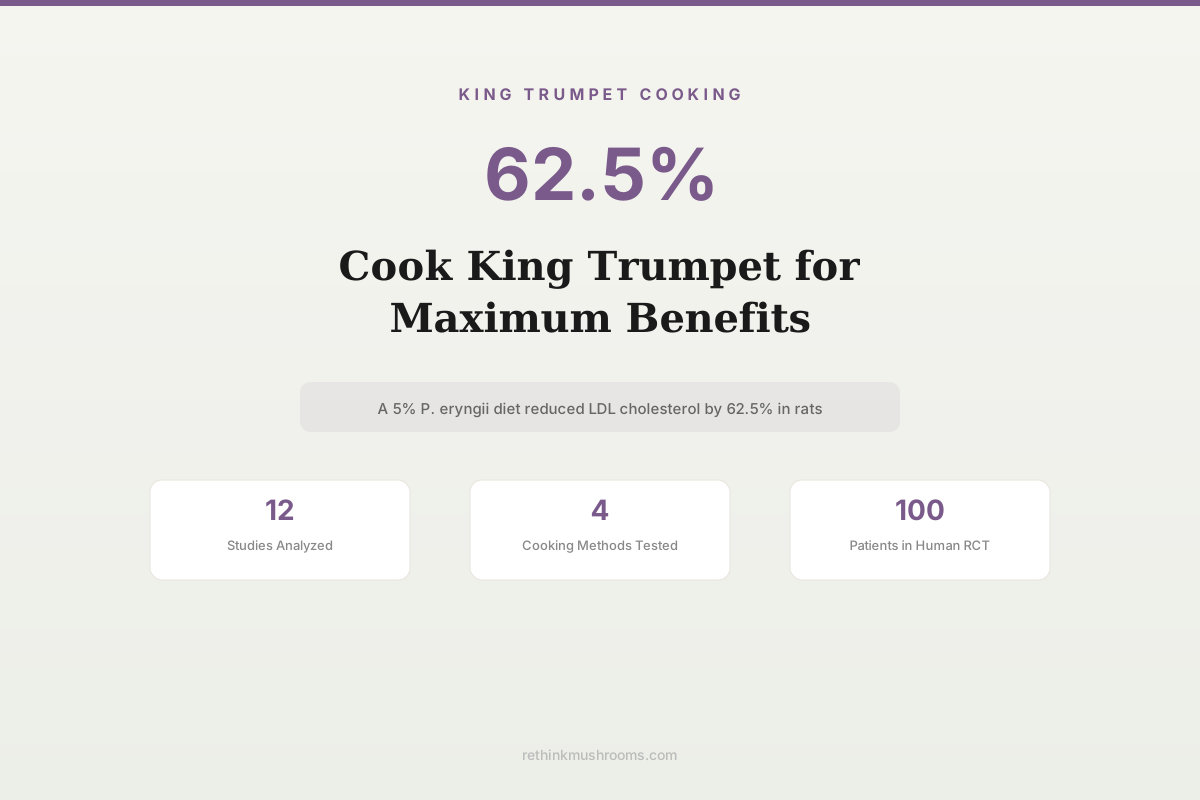
62.5% LDL reduction
A 5% king oyster mushroom diet reduced LDL cholesterol by 62.5% in hypercholesterolemic rats, while a 2022 human RCT found baked P. eryngii snacks reduced glucose, body weight, and IL-6 in metabolically unhealthy patients.
Alam et al., Saudi J Biol Sci, 2011; Kleftaki et al., Antioxidants, 2022
12 Studies
on P. eryngii cooking and bioactivity
4 Methods
tested: grill, microwave, boil, fry
100 Patients
in the 2022 baked mushroom RCT
Alam et al., Saudi J Biol Sci, 2011; Kleftaki et al., Antioxidants, 2022
 View as image ↗
King trumpet mushrooms (Pleurotus eryngii) contain beta-glucans, ergothioneine, phenolic compounds, and polysaccharides with demonstrated antioxidant, lipid-lowering, and immunomodulatory properties. But how you prepare them determines how much of that bioactivity survives your kitchen. A 2017 study testing four cooking methods on P. eryngii found that grilling and microwaving preserved antioxidant capacity while boiling and frying caused the steepest losses.[1] The paradox: boiling reduced antioxidants but increased the beta-glucan fraction. Each cooking method creates a different nutritional trade-off. For a complete overview of king trumpet nutrition, see the dedicated breakdown. For broader context on cooking methods across all mushroom species, see the companion guide.
Key Takeaways
- Grilling and microwaving P. eryngii preserved the highest antioxidant activity among four cooking methods tested, while boiling and frying caused the steepest antioxidant losses (Roncero-Ramos et al., 2017)
- Boiling increased total glucan content by enhancing the beta-glucan fraction in P. eryngii, despite reducing overall antioxidant capacity (Roncero-Ramos et al., 2017)
- Freeze-dried P. eryngii retained total phenolic content of 1,090 mcg GAE/g dry weight compared to 314 mcg after boiling, a 71% reduction (Li and Shah, 2013)
- A 5% P. eryngii diet reduced plasma LDL cholesterol by 62.5%, triglycerides by 46.3%, and total cholesterol by 24% in hypercholesterolemic rats (Alam et al., 2011)
- Baked UV-irradiated P. eryngii snacks reduced glucose, body weight, fat mass, waist circumference, LDL, IL-6, and oxidized LDL in a 3-month RCT of 100 metabolically unhealthy patients (Kleftaki et al., 2022)
- Ergothioneine from mushrooms has high thermal stability and demonstrated bioavailability in human red blood cells after consumption (Weigand-Heller et al., 2012; Kalaras et al., 2017)
How Cooking Methods Change King Trumpet Nutrition
Roncero-Ramos et al. (2017) tested four domestic cooking methods on P. eryngii alongside three other cultivated mushroom species: boiling, microwaving, grilling, and deep frying. The study measured proximate composition (protein, fat, carbohydrates, ash) and antioxidant capacity using DPPH and FRAP assays.[1]
The results showed that cooking method selection produced measurably different nutritional outcomes:
- Frying caused the most severe losses in protein, ash, and carbohydrate content while increasing fat and caloric density from oil absorption
- Boiling improved total glucan content by enhancing the beta-glucan fraction, the polysaccharide class responsible for immunomodulatory and cholesterol-lowering activity
- Grilling and microwaving preserved the highest antioxidant values, with Maillard reaction products potentially contributing to elevated antioxidant readings at 420 nm absorbance
The study concluded that microwaving and grilling are the best processes to maintain the overall nutritional profile of mushrooms, including P. eryngii. This matters because the bioactive compounds in king trumpets are not equally heat-stable, and the cooking medium (oil, water, dry heat) determines which compounds leach out, degrade, or concentrate. For the related question of how king trumpets compare to meat as a protein source, see the dedicated analysis.
Method vs. Compound
No Single Best Method — Each One Trades One Compound for Another
How you cook king trumpet (Pleurotus eryngii) decides which bioactives survive. Dry heat protects antioxidants; boiling sacrifices phenolics but frees more beta-glucans; ergothioneine is heat-stable and survives every method. Match the method to the compound you care about.
Grilling
Dry, high
Highest antioxidant retention; Maillard browning adds melanoidin antioxidants.
Microwaving
Dry, rapid
Ties grilling for antioxidant retention; no leaching medium, short exposure.
Boiling
Wet, prolonged
Free phenolics drop 316 to 95 mcg GAE/g DW, but the beta-glucan fraction rises. Consume the liquid.
Deep frying
Oil, very high
Broadest bioactive losses plus added caloric density from oil absorption.
Ratings are directional, drawn from the cited measurements — not a universal scale. Boiling’s antioxidant loss is real, but so is its beta-glucan gain, which is why the “best” method depends on your goal.
Source: Roncero-Ramos 2017; Li & Shah 2013; Kalaras 2017 (see references)
Grilling and Microwaving: Best for Antioxidant Retention
The antioxidant advantage of dry-heat methods has a specific biochemical explanation. When king trumpet tissue is exposed to temperatures above 100 degrees C without a water medium, phenolic compounds and other antioxidant molecules remain trapped in the cellular matrix rather than leaching into cooking liquid. The Maillard reaction between amino acids and reducing sugars at the mushroom surface generates melanoidins, brown-colored polymers with their own antioxidant activity.[1]
Petraglia et al. (2023) characterized the specific antioxidant mechanisms of P. eryngii polysaccharides. An enriched polysaccharide fraction (EPF) from fruiting bodies scavenged DPPH radicals with an IC50 of 0.52 mg/mL, superoxide radicals at 1.15 mg/mL, hydroxyl radicals at 0.89 mg/mL, and nitric oxide radicals at 2.83 mg/mL. The EPF also counteracted hydrogen peroxide-induced reactive oxygen species production in DI-TNC1 cells at concentrations of 0.05 to 0.2 mg/mL.[2]
These polysaccharide-based antioxidants are more heat-stable than smaller phenolic molecules, which partly explains why grilled and microwaved mushrooms retain higher total antioxidant readings: the polysaccharide fraction survives intact while the Maillard products add to the total. Frying degrades both fractions because the high oil temperature (typically 170 to 190 degrees C) exceeds the thermal tolerance of phenolics and partially degrades polysaccharide chain integrity.
Boiling: The Beta-Glucan Trade-Off
The counterintuitive finding from Roncero-Ramos et al. (2017) is that boiling, despite reducing antioxidant capacity, actually increased the beta-glucan fraction in the mushroom tissue.[1] This happens because hot water disrupts the fungal cell wall, releasing beta-glucans from the chitin-glucan matrix and making them more accessible. The water-soluble phenolics leach into the cooking liquid, which is why antioxidant readings in the mushroom tissue drop, but the structural polysaccharides remain embedded in the tissue.
This trade-off matters because beta-glucans from P. eryngii have demonstrated specific biological activities that phenolic compounds do not replicate. Wang et al. (2022) isolated a beta-1,6-glucan (APEP-A-b) from P. eryngii fruiting bodies and found that it increased splenic lymphocyte proliferation, NK cell activity, and phagocytic capacity of peritoneal phagocytes. The proportion of CD4+ and CD8+ T cells in the lamina propria increased with supplementation. The glucan also increased the relative abundance of Lachnospiraceae and Rikenellaceae bacteria and raised acetic and butyric acid concentrations in cecum contents.[3]
If the goal is immunomodulation or cholesterol reduction, boiling or making a broth with king trumpets may extract more of the relevant compounds than dry-heat methods, provided the cooking liquid is consumed. If the goal is total antioxidant intake, grilling or microwaving preserves more of the complete bioactive profile.
What Happens to Phenolic Compounds Under Heat
Li and Shah (2013) conducted the most detailed analysis of heat effects on P. eryngii phenolics specifically. They compared freeze-dried, oven-dried, and boiling-treated samples using HPLC-DAD analysis, identifying eight distinct phenolic compounds.[4]
The total phenolic content followed a clear hierarchy:
| Processing Method | Free Phenolics (mcg GAE/g DW) | Bound Phenolics (mcg GAE/g DW) | Total Phenolics (mcg GAE/g DW) |
|---|---|---|---|
| Freeze-dried | 316 | 774 | 1,090 |
| Oven-dried | 443 | 487 | 930 |
| Boiling-treated | 95 | 218 | 314 |
Bound phenolics contributed 71% of total phenolic content in freeze-dried samples and 70% in boiling-treated samples, indicating that the bound fraction is proportionally stable even when absolute amounts drop. The free phenolic fraction showed the most dramatic losses during boiling (from 316 to 95 mcg GAE/g DW), consistent with water-soluble phenolic leaching.
Antioxidant activity varied by assay type. Freeze-dried free phenolics showed the strongest DPPH radical scavenging (IC50 at 32.61 mcg/mL). Oven-dried free phenolics showed the strongest reducing power (IC50 at 26.31 mcg/mL). Boiling-treated bound phenolics showed the strongest superoxide anion radical scavenging (IC50 at 14.07 mcg/mL). This means boiling does not destroy all antioxidant function; it selectively concentrates the bound fraction's superoxide-scavenging capacity.[4]
For practical cooking rather than laboratory processing, these numbers suggest that brief, high-heat exposure (grilling, pan-searing) preserves more of the free phenolic fraction than prolonged water contact. Extended boiling (more than 10 minutes) causes the most severe free phenolic losses.
Ergothioneine: The Heat-Stable Advantage
King trumpets contain ergothioneine, a sulfur-containing amino acid with antioxidant properties that distinguishes mushrooms from nearly all other food sources. Kalaras et al. (2017) measured ergothioneine levels across multiple mushroom species and found concentrations ranging from 0.15 to 7.27 mg per gram dry weight, with higher concentrations in the cap (pileus) than in the stem (stipe).[5] Glutathione levels ranged from 0.11 to 2.41 mg per gram dry weight and correlated with ergothioneine levels (r = 0.62, p < 0.001).
Ergothioneine has a critical practical advantage for cooking: it is thermally stable. Unlike phenolic compounds that degrade or leach during heat exposure, ergothioneine retains its structure across a range of cooking temperatures. Weigand-Heller et al. (2012) demonstrated that ergothioneine from mushrooms is bioavailable in humans, with red blood cell uptake confirmed postprandially. Consumption was associated with an attenuated postprandial triglyceride response.[6]
This means that regardless of whether you grill, boil, saute, or microwave king trumpet mushrooms, the ergothioneine content is likely to survive cooking largely intact. The body absorbs ergothioneine through a dedicated transporter (SLC22A4) expressed on the small intestine's apical membrane, and the kidneys actively reabsorb it, resulting in tissue accumulation over time. Ergothioneine concentrates in tissues with high oxidative stress exposure: red blood cells, liver, bone marrow, lens of the eye, and seminal fluid. For detailed preparation techniques that preserve king trumpet texture and health compounds, see the preparation guide.
King Trumpet and Metabolic Health: Why Cooking Matters
The reason cooking method selection matters extends beyond abstract nutrient retention. The compounds preserved or enhanced by different methods produce measurable health outcomes in preclinical and clinical research.
Alam et al. (2011) fed hypercholesterolemic rats a diet containing 5% dried P. eryngii powder and measured dramatic lipid changes: plasma LDL cholesterol dropped 62.5%, triglycerides dropped 46.3%, total cholesterol dropped 24%, and the LDL/HDL ratio dropped 57.1%. Fecal lipid and cholesterol excretion increased, confirming that the mushroom promoted lipid clearance rather than simply blocking absorption. Liver histology remained normal in mushroom-fed animals despite their hypercholesterolemic diet.[7]
Nakahara et al. (2020) identified the specific polysaccharide fraction responsible. Hot-water-soluble polysaccharides from P. eryngii at 5% dietary concentration reduced body weight gain and mesenteric fat in mice on a high-fat diet. Serum total cholesterol and LDL cholesterol decreased. Fecal bile acid excretion increased, and the expression of the LDLR gene in the liver upregulated, meaning the liver actively pulled more LDL from circulation. The gut microbiota composition shifted, with increases in short-chain fatty acid-producing bacteria.[8]
Wei et al. (2018) demonstrated that P. eryngii polysaccharides from solid-state fermentation reduced lipid accumulation in macrophage-derived foam cells and lowered lipid levels in zebrafish models, identifying a direct mechanism for the cholesterol-lowering effects.[9]
Du et al. (2024) advanced this line of research using whole mushroom rather than isolated fractions. Dietary intake of whole P. eryngii in mice inhibited abnormal body weight gain, improved glucose tolerance, reduced non-alcoholic fatty liver severity, and increased short-chain fatty acid levels in the cecum. The gut microbiota shifted favorably, with increases in Akkermansia, Lactobacillus, Bifidobacterium, and Sutterella and decreases in several harmful genera.[10]
The only human RCT on this topic comes from Kleftaki et al. (2022), who tested UV-irradiated baked P. eryngii mushroom snacks on 100 metabolically unhealthy patients over three months. The intervention group showed reduced glucose levels, body weight, fat mass, waist circumference, hip circumference, LDL cholesterol, SGOT, IL-6, and oxidized LDL compared to the control group. Serum 25(OH)D2 increased, confirming vitamin D2 absorption from the UV-treated mushrooms.[11]
The baking method used in the Kleftaki trial is a dry-heat method similar to roasting. This is consistent with the Roncero-Ramos finding that dry-heat methods preserve more antioxidant compounds than boiling or frying. The positive clinical outcomes in the RCT occurred with baked mushrooms, providing indirect evidence that dry-heat preparation retains enough bioactivity to produce measurable metabolic improvements in humans.
Kleftaki et al. (2022) · Antioxidants
- Population
- 100 metabolically unhealthy adults
- Intervention
- Daily baked, UV-irradiated P. eryngii snack (a dry-heat preparation)
- Comparator
- Control group over 3 months
- Finding
- The mushroom group showed reductions in glucose, body weight, fat mass, waist and hip circumference, LDL cholesterol, SGOT, IL-6, and oxidized LDL, plus a rise in serum 25(OH)D2 confirming vitamin D2 absorption.
positive This is the single human trial on cooked king trumpet and it used a dry-heat method — the same category the antioxidant-retention studies favor. One RCT is a promising signal, not settled proof; it needs replication before firm dietary claims.
Kleftaki et al., Antioxidants, 2022
Reading the evidence — animal vs. human
ModerateThe biggest cholesterol numbers here come from rats, not people
Concern
The headline figures — LDL down 62.5%, triglycerides down 46.3% — come from a study feeding a 5% mushroom diet to hypercholesterolemic rats (Alam et al., 2011). Rodents metabolize lipids differently than humans, and a 5% dietary share is far higher than a typical human meal. The strongest human result (Kleftaki 2022) is real but modest, from a single trial. No study shows that eating king trumpet mushrooms will lower a person's cholesterol by anything like the rat figures.
What the research says
Treat king trumpet as a nutritious food with promising metabolic signals, not as a cholesterol treatment. If you take lipid-lowering medication or are managing a diagnosed condition, keep taking it and make dietary changes alongside — not instead of — your prescribed care.
Particularly relevant for: Anyone using mushrooms to manage cholesterol, glucose, or a diagnosed metabolic condition
What to do
Discuss dietary changes with your physician before altering treatment. This article is educational and is not medical advice.
Calibration based on Alam et al., 2011 (rat model) and Kleftaki et al., 2022 (human RCT)
Practical Preparation for Bioactive Retention
Combining the research above, a practical framework emerges for cooking king trumpet mushrooms based on your nutritional priorities:
For maximum antioxidant retention: Grill thick slices (1 cm or more) over medium heat for 3 to 4 minutes per side, or microwave for 2 to 3 minutes. Avoid submerging in water or oil. Pan-searing with minimal oil is a reasonable compromise that preserves most antioxidant activity while developing the Maillard browning that adds both flavor and melanoidin antioxidants.
For maximum beta-glucan extraction: Simmer sliced king trumpets in soup, broth, or stew for 15 to 20 minutes. The beta-glucan fraction increases with hot water exposure, and consuming the liquid captures the phenolics that leach from the mushroom tissue. This is the method most aligned with the polysaccharide studies showing immune and cholesterol benefits.
For ergothioneine: Any cooking method works. Ergothioneine is thermally stable and survives all standard kitchen temperatures. The only consideration is not discarding cooking liquid if you boil or simmer, as some ergothioneine will transfer to the water.
For maximum vitamin D2: If using UV-exposed king trumpets, baking or roasting preserves the vitamin D2 content. The Kleftaki RCT used baked mushrooms specifically, and the participants showed increased serum 25(OH)D2.
What to avoid: Deep frying degrades the broadest range of bioactive compounds while adding the most caloric density from oil absorption. Extended boiling (more than 20 minutes) without consuming the liquid wastes the most water-soluble nutrients. Lo et al. (2012) found that bioactive compound content varies between fruiting bodies and mycelia across mushroom species, confirming that starting with whole fruiting bodies (the part you buy fresh) provides the most complete bioactive profile for cooking.[12]
For creative preparation ideas like making king trumpet scallops, the pan-searing method used to achieve the scallop texture also happens to preserve most bioactive compounds.
The Bottom Line
Research on king trumpet mushroom preparation reveals that cooking method selection creates distinct nutritional trade-offs. Grilling and microwaving preserve the highest antioxidant activity, while boiling enhances beta-glucan availability at the cost of phenolic compounds. Ergothioneine, one of the most distinctive bioactive compounds in king trumpets, survives all standard cooking methods. The only human RCT used baked mushrooms and demonstrated metabolic improvements over three months, suggesting that dry-heat preparation retains sufficient bioactivity for clinical benefit.
Frequently Asked Questions
Sources & References
- 1RTHM-00488·Roncero-Ramos, Irene et al. (2017). “Effect of different cooking methods on nutritional value and antioxidant activity of cultivated mushrooms..” International journal of food sciences and nutrition.Study breakdown →PubMed →↩
- 2RTHM-00847·Petraglia, Tania et al. (2023). “Antioxidant Activity of Polysaccharides from the Edible Mushroom Pleurotus eryngii..” Molecules (Basel.Study breakdown →PubMed →↩
- 3RTHM-00801·Wang, Xue et al. (2022). “β-1,6-Glucan From Pleurotus eryngii Modulates the Immunity and Gut Microbiota..” Frontiers in immunology.Study breakdown →PubMed →↩
- 4RTHM-00296·Li, Siqian et al. (2013). “Effects of various heat treatments on phenolic profiles and antioxidant activities of Pleurotus eryngii extracts..” Journal of food science.Study breakdown →PubMed →↩
- 5RTHM-00476·Kalaras, Michael D et al. (2017). “Mushrooms: A rich source of the antioxidants ergothioneine and glutathione..” Food chemistry.Study breakdown →PubMed →↩
- 6RTHM-00270·Weigand-Heller, AuBrei J et al. (2012). “The bioavailability of ergothioneine from mushrooms (Agaricus bisporus) and the acute effects on antioxidant capacity and biomarkers of inflammation..” Preventive medicine.Study breakdown →PubMed →↩
- 7RTHM-00204·Alam, Nuhu et al. (2011). “Dietary effect of Pleurotus eryngii on biochemical function and histology in hypercholesterolemic rats..” Saudi journal of biological sciences.Study breakdown →PubMed →↩
- 8RTHM-00643·Nakahara, Daiki et al. (2020). “Effect of mushroom polysaccharides from Pleurotus eryngii on obesity and gut microbiota in mice fed a high-fat diet..” European journal of nutrition.Study breakdown →PubMed →↩
- 9RTHM-00534·Wei, Hua et al. (2018). “Lipid-Lowering Effect of the Pleurotus eryngii (King Oyster Mushroom) Polysaccharide from Solid-State Fermentation on Both Macrophage-Derived Foam Cells and Zebrafish Models..” Polymers.Study breakdown →PubMed →↩
- 10RTHM-00876·Du, Hengjun et al. (2024). “Dietary intake of whole king oyster mushroom (Pleurotus eryngii) attenuated obesity via ameliorating lipid metabolism and alleviating gut microbiota dysbiosis..” Food research international (Ottawa.Study breakdown →PubMed →↩
- 11RTHM-00771·Kleftaki, Stamatia-Angeliki et al. (2022). “A Randomized Controlled Trial on Pleurotus eryngii Mushrooms with Antioxidant Compounds and Vitamin D2 in Managing Metabolic Disorders..” Antioxidants (Basel.Study breakdown →PubMed →↩
- 12RTHM-00256·Lo, Yu-Chang et al. (2012). “Comparative study of contents of several bioactive components in fruiting bodies and mycelia of culinary-medicinal mushrooms..” International journal of medicinal mushrooms.Study breakdown →PubMed →↩