Antrodia Cultivation
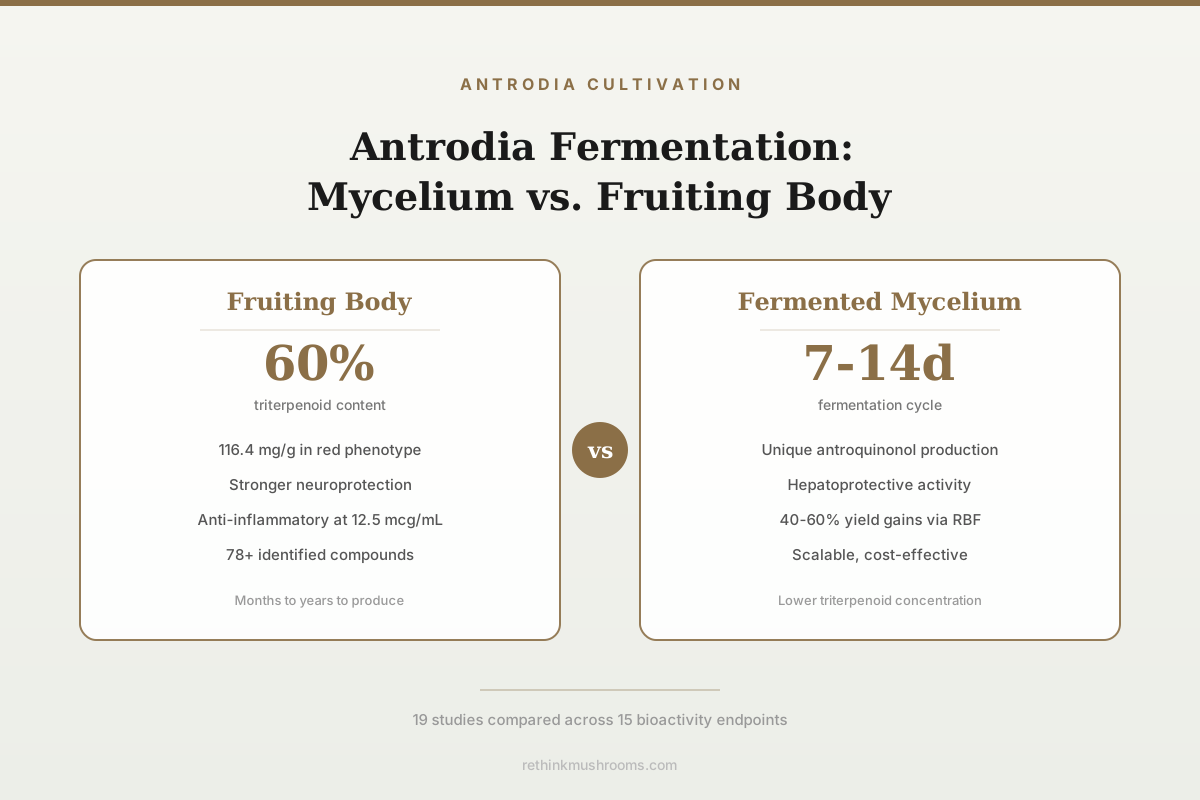
60% triterpenoids
Triterpenoids account for roughly 60% of total fruiting body constituents in Antrodia camphorata, compared to trace levels in some mycelial preparations.
Geethangili & Tzeng, Evidence-Based CAM, 2011
116.4 mg/g
triterpenoids in red fruiting body phenotype
7-14 days
liquid fermentation cycle vs. months for fruiting body
15 Studies
comparing mycelium and fruiting body forms
Geethangili & Tzeng, Evidence-Based CAM, 2011
 View as image ↗
Antrodia camphorata produces different bioactive compound profiles depending on whether it grows as a fruiting body on its native host tree or as mycelium in fermentation tanks. This distinction matters because the majority of commercial Antrodia products use fermented mycelium rather than wild or wood-cultivated fruiting bodies. The fruiting body form contains higher concentrations of triterpenoids and phenolic compounds, while mycelium fermentation products contain unique metabolites like antroquinonol and specific polysaccharide fractions. Neither form is universally "better." Each produces distinct compounds with different pharmacological profiles. The question is which compounds match the outcome of interest. For a broader overview of Antrodia's bioactive compound classes, see the guide on Antrodia bioactive compounds. The cost dynamics behind why wild fruiting bodies remain so expensive are covered in why wild Antrodia costs so much.
Key Takeaways
- Fruiting bodies contained higher triterpenoid content (116.4 mg/g in red phenotype) and total phenols compared to mycelium, with 60% of fruiting body constituents being triterpenoids (Geethangili and Tzeng, 2011)
- Fruiting body extracts showed stronger neuroprotection than mycelium in both cell culture and animal models of Alzheimer's disease, suppressing hyperphosphorylated tau protein that mycelium did not affect (Wang et al., 2012)
- Wild fruiting body, liquid-state fermentation, and solid-state culture all inhibited NO production in activated microglia, but the wild fruiting body extract was effective at 12.5 microg/mL while fermented forms required higher concentrations (Liu et al., 2007)
- Liquid fermentation mycelium still produces hepatoprotective compounds: fermented filtrate reduced CCl4-induced liver damage markers (AST, ALT, LDH) in rats by restoring antioxidant enzyme activity (Song and Yen, 2003)
- Repeated batch fermentation shortened production from 80 to 58 days while improving triterpenoid, polysaccharide, and antroquinonol yields by 40-60% over conventional methods (Li et al., 2015)
- Combining fruiting body extract with solid-state-cultivated mycelia enhanced NK cell cytotoxicity and shifted immune balance toward Th1 dominance at lower doses than mycelia alone (Lin et al., 2019)
Triterpenoid Content: The Central Divide
The most consistent difference between Antrodia fruiting body and mycelium is triterpenoid concentration. Geethangili and Tzeng (2011) documented in their comprehensive pharmacological review that triterpenoids account for approximately 60% of total fruiting body constituents, encompassing over 78 identified compounds including ergostane and lanostane-type triterpenoids, benzenoids, lignans, and benzoquinone derivatives.[1]
The gap varies by fruiting body phenotype. Red-pigmented Antrodia fruiting bodies yield 116.4 mg/g of triterpenoids, yellow forms yield 63.9 mg/g, and white forms yield 51.3 mg/g. By contrast, solid-state fermented mycelium produces primarily antrodins A, B, and C rather than the ergostane-type triterpenoids found in fruiting bodies. Under optimized solid fermentation, antrodin C reached 6,617 mg/kg, but the typical triterpene compounds associated with fruiting body pharmacology were largely absent.[1]
Zhao and Leung (2010) developed HPLC-DAD-MS methods to quantify bioactive compounds in mycelial Antrodia specifically because the chemical profile differs so substantially from fruiting bodies that quality control requires separate analytical standards.[2] Their analysis confirmed that mycelial products require their own quality markers rather than borrowing fruiting body compound benchmarks.
This does not mean mycelium lacks bioactive triterpenoids entirely. Lu et al. (2011) optimized fermentation media for triterpenoid production from submerged A. camphorata ATCC 200183 using response surface methodology and artificial neural networks, identifying inoculum size and specific medium components as the critical variables.[3] Optimized conditions produced measurable triterpenoid yields (63-532 mg/L depending on strain), though these remain below fruiting body concentrations on a per-gram basis.
Host tree chemistry plays a direct role. Hsu et al. (2006) identified polysaccharide-based hyphal growth-promoting factors from Cinnamomum camphora, the native host wood, that stimulated Antrodia growth and altered its chemical profile at concentrations of 80-320 mg per wood piece.[4] Without these host-derived signals, mycelium develops a fundamentally different metabolite fingerprint. This finding helps explain why even wood-based solid-state culture on non-Cinnamomum substrates fails to replicate the wild fruiting body profile. For more on how solid-state and submerged cultivation methods compare, see the dedicated analysis.
Neuroprotective Activity: Fruiting Body Advantage
Wang et al. (2012) conducted the most direct head-to-head comparison of fruiting body and mycelium neuroprotective effects. In both in vitro PC-12 cell models and in vivo amyloid-beta (Abeta40) infused rat brains, the fruiting body preparation outperformed mycelium.[5]
The fruiting body extract showed stronger antioxidative and anti-inflammatory properties against Abeta40-induced neurotoxicity. In the PC-12 cell model, fruiting body extracts reduced oxidative stress markers and inflammatory cytokines at lower concentrations than mycelium extracts. In the rat model, fruiting body treatment reduced Abeta40 accumulation in brain tissue more effectively than mycelium.
The starkest difference involved hyperphosphorylated tau (p-tau) protein, a key Alzheimer's disease biomarker. Fruiting body treatment suppressed p-tau expression while mycelium treatment had no measurable effect on this marker.[5] This is mechanistically significant because both Abeta accumulation and tau hyperphosphorylation are required for Alzheimer's pathology. A compound that addresses only one arm provides incomplete neuroprotection.
Wang et al. attributed the fruiting body's superiority to its higher triterpenoid and total phenol content. The correlation between triterpenoid concentration and neuroprotective potency supports the broader pattern: pharmacological activities driven primarily by triterpenoids will favor fruiting body preparations. For a broader review of this evidence, see the article on Antrodia and brain health.
Anti-Inflammatory Comparison Across All Three Forms
Liu et al. (2007) tested all three major Antrodia preparations (wild fruiting body, liquid-state fermentation product, and solid-state culture mycelium) against each other in BV-2 microglial cells stimulated with lipopolysaccharide.[6]
All three forms inhibited nitric oxide (NO) production, but the effective concentrations differed. The wild fruiting body methanol extract began suppressing NO at 12.5 microg/mL, while the fermented products required higher concentrations for equivalent suppression. At 100 microg/mL, the wild fruiting body extract reduced NO production by approximately 80%.
Each form also modulated iNOS and COX-2 protein expression, the enzymatic sources of inflammatory NO and prostaglandins. The wild fruiting body extract was the most potent inhibitor of both enzymes. The three forms showed differential effects on NF-kappaB signaling: all suppressed NF-kappaB activation, but through partially distinct mechanisms depending on the compound profile of each preparation.[6]
This study is valuable because it used the same experimental conditions for all three forms, eliminating inter-study variability. The conclusion that wild fruiting body is most potent, solid-state culture is intermediate, and liquid-state fermentation is least potent for anti-inflammatory activity provides a clear hierarchy for this specific endpoint. For more on Antrodia's anti-inflammatory mechanisms, see the article on Antrodia anti-inflammatory triterpenoid research.
Polysaccharide Immunomodulation: Both Forms Active
Polysaccharides tell a different story than triterpenoids. Meng et al. (2012) extracted polysaccharides from both Antrodia mycelium and fruiting bodies and tested them in a polymicrobial sepsis mouse model.[7]
Both mycelium-derived and fruiting body-derived polysaccharides modulated inflammatory mediator expression in septic mice. The polysaccharides from both sources affected cytokine profiles, though with somewhat different patterns reflecting their distinct sugar compositions. This is consistent with the broader mushroom immunology literature: polysaccharide immunomodulation depends more on structural features (branching patterns, molecular weight, glycosidic linkages) than on absolute concentration.
Lin et al. (2019) tested a product combining fruiting body extract with solid-state-cultivated mycelia and found enhanced immunomodulatory effects at lower doses than mycelia alone. The combination increased NK cell cytotoxicity at effector-to-target ratios of 5:1, 10:1, and 25:1. It elevated IL-2 and IFN-gamma while suppressing IL-4, IL-5, and IgE, shifting the Th1/Th2 balance toward cellular immunity.[8]
This finding suggests that for immune endpoints, the mycelium and fruiting body components may be complementary rather than interchangeable. The fruiting body contributes concentrated triterpenoids while the mycelium contributes specific polysaccharide fractions and unique metabolites. The two sources activate overlapping but non-identical immune pathways. For more detail on Antrodia's polysaccharide-specific immune mechanisms, see the dedicated analysis.
Hepatoprotection: Where Mycelium Holds Its Own
Liver protection is one domain where mycelium fermentation products perform well independently of fruiting body triterpenoids. Two early studies established this.
Song and Yen (2002) demonstrated that submerged-culture Antrodia produced antioxidant compounds in the culture medium itself, the filtrate, and the mycelial extracts. The dry matter of the cultural medium and filtrate showed DPPH radical scavenging activity, reducing power, and chelation of ferrous ions, correlated with total polyphenols, crude triterpenoids, and protein/polysaccharide content.[9]
Song and Yen (2003) then tested the fermented filtrate from submerged culture against CCl4-induced liver toxicity in rats. The filtrate protected HepG2 cells from H2O2-induced cytotoxicity in vitro and reduced serum AST, ALT, and LDH in CCl4-treated rats. The protection correlated with restored hepatic antioxidant enzyme activities (superoxide dismutase, catalase, glutathione peroxidase) and reduced lipid peroxidation markers.[10]
Wang et al. (2013) added a novel variable: culturing Antrodia in deep ocean water instead of standard water increased production of triterpenoids, polysaccharides, flavonoids, and polyphenols. The deep-ocean-water-cultured product provided stronger protection against thioacetamide-induced liver fibrosis than the standard-water control, with reduced collagen deposition and alpha-smooth muscle actin expression.[11]
Kim et al. (2024) confirmed mycelium hepatoprotection with the most recent data: Antrodia mycelium powder reduced alcohol-induced liver damage markers in both cell culture and animal models, demonstrating that fermented mycelium retains meaningful hepatoprotective activity without fruiting body-level triterpenoid concentrations.[12] For broader context on Antrodia's liver research, see the article on Antrodia and alcohol-related liver damage.
Fermentation Engineering: Closing the Gap
The triterpenoid gap between mycelium and fruiting body has driven two decades of fermentation optimization research.
Lu et al. (2014) found that adding alpha-terpineol (a terpenoid precursor compound) to submerged culture of Antrodia cinnamomea substantially increased triterpenoid yields. The alpha-terpineol acted as both a precursor and an elicitor, stimulating the mevalonate pathway that synthesizes triterpenoid backbones.[13]
Meng et al. (2021) demonstrated that adding vegetable oil to liquid fermentation increased triterpenoid production in Antrodia cinnamomea, leveraging lipid metabolism connections to the terpenoid biosynthesis pathway.[14]
Li et al. (2015) addressed the practical bottleneck of fermentation time. Conventional submerged fermentation requires 10-14 days per batch with tedious inoculum preparation. Their asexual reproduction-based repeated batch fermentation (RBF) process shortened the total production time from 80 to 58 days for five successive batches while improving productivities of triterpenoids by 40%, polysaccharides by 60%, and antroquinonol by 52% compared to conventional batch fermentation.[15]
Geng et al. (2013) discovered that A. camphorata ATCC 200183 sporulates asexually in submerged culture, producing arthroconidia that can serve as inoculum. Optimal sporulation occurred with soluble starch and yeast extract at a carbon-to-nitrogen ratio of 40:1, initial pH 5.0, and inoculum size of 1.5 x 10^5 spores/mL.[16] This finding enabled the repeated batch process by providing a consistent, scalable inoculum source.
The Wild Fruiting Body's Unique Chemistry
Lu et al. (2009) demonstrated why the wild fruiting body retains interest despite fermentation advances. Ethanol extracts from wild Antrodia camphorata fruiting bodies (EEAC) induced apoptosis in leukemia HL-60 cells through a histone hypoacetylation mechanism, and synergized with the HDAC inhibitor trichostatin A to enhance anticancer effects.[17]
This synergistic interaction with an epigenetic drug suggests that wild fruiting body compounds access mechanisms not replicated by fermented mycelium. The histone modification pathway is particularly relevant because it affects gene expression broadly rather than targeting a single receptor or enzyme. This type of pleiotropic activity is consistent with the complex triterpenoid mixture found exclusively in wild fruiting bodies grown on their Cinnamomum host.
Tsai et al. (2015) confirmed anti-inflammatory activity of Antrodia in a different model: mouse skin ischemia. The study showed that Antrodia reduced ischemia-reperfusion injury through suppression of inflammatory pathways, adding to the evidence that Antrodia's anti-inflammatory effects extend across tissue types and inflammatory stimuli.[18]
What Matters for Product Selection
The general metabolite comparison literature confirms that mycelium and fruiting bodies of edible fungi produce meaningfully different chemical profiles. Berger et al. (2022) reviewed metabolite differences across multiple edible fungi species and concluded that substrate chemistry, strain, developmental stage, and ecological interactions all create wide variation in both mycelial and fruiting body compositions.[19] This variability means blanket statements about one form being "better" collapse under the specifics of which compounds, which strain, and which production conditions.
For Antrodia specifically, the evidence patterns are:
Fruiting body advantages: Higher triterpenoid concentration (by 2-10x depending on cultivation method), stronger neuroprotective effects, more potent anti-inflammatory activity in head-to-head comparisons, unique compound profiles not replicated by fermentation.
Mycelium fermentation advantages: Scalable production (days vs. months), meaningful hepatoprotective activity via polysaccharides and antioxidant compounds, unique metabolites like antroquinonol not found in fruiting bodies, combinable with fruiting body extracts for synergistic immune effects.
Neither form advantages: Polysaccharide-based immunomodulation works from both sources through partially distinct but overlapping receptor pathways (TLR2, TLR4, Dectin-1).
The primary limitation across this literature is the absence of human clinical trials directly comparing mycelium and fruiting body preparations for any health endpoint. All comparisons are from cell culture, animal models, or chemical analysis. Whether the in vitro and in vivo potency differences translate to different outcomes in humans remains untested.
The Bottom Line
Antrodia camphorata fruiting bodies and fermented mycelium produce distinct chemical profiles with different pharmacological strengths. Fruiting bodies contain substantially higher triterpenoid concentrations and show greater potency for neuroprotection and anti-inflammatory activity in laboratory comparisons. Mycelium fermentation products contribute meaningful hepatoprotective activity, unique compounds like antroquinonol, and immunomodulatory polysaccharides. Recent fermentation engineering has narrowed the triterpenoid gap by 40-60% through optimized media and repeated batch processes, but has not eliminated it. No human trials have directly compared the two forms.
Frequently Asked Questions
Sources & References
- 1RTHM-00214·Geethangili, Madamanchi et al. (2011). “Review of Pharmacological Effects of Antrodia camphorata and Its Bioactive Compounds..” Evidence-based complementary and alternative medicine : eCAM.Study breakdown →PubMed →↩
- 2RTHM-00202·Zhao, Sandy Shuo et al. (2010). “Quality evaluation of mycelial Antrodia camphorata using high-performance liquid chromatography (HPLC) coupled with diode array detector and mass spectrometry (DAD-MS)..” Chinese medicine.Study breakdown →PubMed →↩
- 3RTHM-00226·Lu, Zhen-Ming et al. (2011). “Optimization of fermentation medium for triterpenoid production from Antrodia camphorata ATCC 200183 using artificial intelligence-based techniques..” Applied microbiology and biotechnology.Study breakdown →PubMed →↩
- 4RTHM-00099·Hsu, Feng-Lin et al. (2006). “Promotion of hyphal growth and underlying chemical changes in Antrodia camphorata by host factors from Cinnamomum camphora..” International journal of food microbiology.Study breakdown →PubMed →↩
- 5RTHM-00269·Wang, Li-Chun et al. (2012). “In vitro and in vivo comparisons of the effects of the fruiting body and mycelium of Antrodia camphorata against amyloid β-protein-induced neurotoxicity and memory impairment..” Applied microbiology and biotechnology.Study breakdown →PubMed →↩
- 6RTHM-00119·Liu, Der-Zen et al. (2007). “Comparative anti-inflammatory characterization of wild fruiting body, liquid-state fermentation, and solid-state culture of Taiwanofungus camphoratus in microglia and the mechanism of its action..” Journal of ethnopharmacology.Study breakdown →PubMed →↩
- 7RTHM-00257·Meng, Ling-Min et al. (2012). “Polysaccharides from extracts of Antrodia camphorata mycelia and fruiting bodies modulate inflammatory mediator expression in mice with polymicrobial sepsis..” Nutrition (Burbank.Study breakdown →PubMed →↩
- 8RTHM-00572·Lin, Liang-Hung et al. (2019). “Immunomodulatory Effects of Fruiting Body Extract and Solid-State-Cultivated Mycelia of Taiwanofungus camphoratus..” Nutrients.Study breakdown →PubMed →↩
- 9RTHM-00051·Song, Tuzz-Ying et al. (2002). “Antioxidant properties of Antrodia camphorata in submerged culture..” Journal of agricultural and food chemistry.Study breakdown →PubMed →↩
- 10RTHM-00062·Song, Tuzz-Ying et al. (2003). “Protective effects of fermented filtrate from Antrodia camphorata in submerged culture against CCl4-induced hepatic toxicity in rats..” Journal of agricultural and food chemistry.Study breakdown →PubMed →↩
- 11RTHM-00309·Wang, Li-Chun et al. (2013). “Antrodia camphorata-fermented product cultured in deep ocean water has more liver protection against thioacetamide-induced fibrosis..” Applied microbiology and biotechnology.Study breakdown →PubMed →↩
- 12RTHM-00886·Kim, Unyong et al. (2024). “Hepatoprotective Effect of Antrodia camphorata Mycelium Powder on Alcohol-Induced Liver Damage..” Nutrients.Study breakdown →PubMed →↩
- 13RTHM-00339·Lu, Zhen-Ming et al. (2014). “Alpha-terpineol promotes triterpenoid production of Antrodia cinnamomea in submerged culture..” FEMS microbiology letters.Study breakdown →PubMed →↩
- 14RTHM-00707·Meng, Linghui et al. (2021). “Addition of Vegetable Oil to Improve Triterpenoids Production in Liquid Fermentation of Medicinal Fungus Antrodia cinnamomea..” Journal of fungi (Basel.Study breakdown →PubMed →↩
- 15RTHM-00388·Li, Hua-Xiang et al. (2015). “Efficient production of bioactive metabolites from Antrodia camphorata ATCC 200183 by asexual reproduction-based repeated batch fermentation..” Bioresource technology.Study breakdown →PubMed →↩
- 16RTHM-00285·Geng, Yan et al. (2013). “Antrodia camphorata ATCC 200183 sporulates asexually in submerged culture..” Applied microbiology and biotechnology.Study breakdown →PubMed →↩
- 17RTHM-00163·Lu, Mei-Chin et al. (2009). “Active extracts of wild fruiting bodies of Antrodia camphorata (EEAC) induce leukemia HL 60 cells apoptosis partially through histone hypoacetylation and synergistically promote anticancer effect of trichostatin A..” Archives of toxicology.Study breakdown →PubMed →↩
- 18RTHM-00406·Tsai, Tung-Chou et al. (2015). “Anti-inflammatory effects of Antrodia camphorata, a herbal medicine, in a mouse skin ischemia model..” Journal of ethnopharmacology.Study breakdown →PubMed →↩
- 19RTHM-00743·Berger, Ralf G et al. (2022). “Mycelium vs. Fruiting Bodies of Edible Fungi-A Comparison of Metabolites..” Microorganisms.Study breakdown →PubMed →↩